本文主要是介绍【DeepLearning-8】MobileViT模块配置,希望对大家解决编程问题提供一定的参考价值,需要的开发者们随着小编来一起学习吧!
完整代码:
import torch
import torch.nn as nn
from einops import rearrange
def conv_1x1_bn(inp, oup):return nn.Sequential(nn.Conv2d(inp, oup, 1, 1, 0, bias=False),nn.BatchNorm2d(oup),nn.SiLU())
def conv_nxn_bn(inp, oup, kernal_size=3, stride=1):return nn.Sequential(nn.Conv2d(inp, oup, kernal_size, stride, 1, bias=False),nn.BatchNorm2d(oup),nn.SiLU())
class PreNorm(nn.Module):def __init__(self, dim, fn):super().__init__()self.norm = nn.LayerNorm(dim)self.fn = fn # mgdef forward(self, x, **kwargs):return self.fn(self.norm(x), **kwargs)
class Attention(nn.Module):def __init__(self, dim, heads=8, dim_head=64, dropout=0.):super().__init__()inner_dim = dim_head *  headsproject_out = not (heads == 1 and dim_head == dim)self.heads = headsself.scale = dim_head ** -0.5self.attend = nn.Softmax(dim = -1)self.to_qkv = nn.Linear(dim, inner_dim * 3, bias = False)self.to_out = nn.Sequential(nn.Linear(inner_dim, dim),nn.Dropout(dropout)# mg) if project_out else nn.Identity()def forward(self, x):qkv = self.to_qkv(x).chunk(3, dim=-1)q, k, v = map(lambda t: rearrange(t, 'b p n (h d) -> b p h n d', h = self.heads), qkv)dots = torch.matmul(q, k.transpose(-1, -2)) * self.scaleattn = self.attend(dots)out = torch.matmul(attn, v)out = rearrange(out, 'b p h n d -> b p n (h d)')return self.to_out(out)
class FeedForward(nn.Module):def __init__(self, dim, hidden_dim, dropout=0.):super().__init__()self.net = nn.Sequential(nn.Linear(dim, hidden_dim),nn.SiLU(),nn.Dropout(dropout),nn.Linear(hidden_dim, dim),nn.Dropout(dropout))def forward(self, x):return self.net(x)
class UserDefined(nn.Module):def __init__(self, dim, depth, heads, dim_head, mlp_dim, dropout=0.):super().__init__()self.layers = nn.ModuleList([])for _ in range(depth):self.layers.append(nn.ModuleList([PreNorm(dim, Attention(dim, heads, dim_head, dropout)),PreNorm(dim, FeedForward(dim, mlp_dim, dropout))]))def forward(self, x):for attn, ff in self.layers:x = attn(x) + xx = ff(x) + xreturn xclass IRBlock(nn.Module):def __init__(self, inp, oup, stride=1, expansion=4):super().__init__()self.stride = strideassert stride in [1, 2]hidden_dim = int(inp * expansion)self.use_res_connect = self.stride == 1 and inp == oupif expansion == 1: # 构建没有扩展层的卷积块self.conv = nn.Sequential(# 深度可分离卷积(Depthwise Convolution)nn.Conv2d(hidden_dim, hidden_dim, 3, stride, 1, groups=hidden_dim, bias=False),nn.BatchNorm2d(hidden_dim),nn.SiLU(),# “线性”逐点卷积 (Pointwise-Linear Convolution)nn.Conv2d(hidden_dim, oup, 1, 1, 0, bias=False),nn.BatchNorm2d(oup),)else:  # 构建包含扩展层的卷积块self.conv = nn.Sequential(# 逐点卷积 (Pointwise Convolution)nn.Conv2d(inp, hidden_dim, 1, 1, 0, bias=False),nn.BatchNorm2d(hidden_dim),nn.SiLU(),# 深度可分离卷积 (Depthwise Convolution)nn.Conv2d(hidden_dim, hidden_dim, 3, stride, 1, groups=hidden_dim, bias=False),nn.BatchNorm2d(hidden_dim),nn.SiLU(),# “线性”逐点卷积 (Pointwise-Linear Convolution)nn.Conv2d(hidden_dim, oup, 1, 1, 0, bias=False),nn.BatchNorm2d(oup),)def forward(self, x):if self.use_res_connect:return x + self.conv(x)else:return self.conv(x)class MobileViTBv3(nn.Module):def __init__(self, channel, dim, depth=2, kernel_size=3, patch_size=(2, 2), mlp_dim=int(64*2), dropout=0.):super().__init__()self.ph, self.pw = patch_sizeself.mv01 = IRBlock(channel, channel) self.conv1 = conv_nxn_bn(channel, channel, kernel_size)self.conv3 = conv_1x1_bn(dim, channel)self.conv2 = conv_1x1_bn(channel, dim)self.transformer = UserDefined(dim, depth, 4, 8, mlp_dim, dropout)self.conv4 = conv_nxn_bn(2 * channel, channel, kernel_size)def forward(self, x):y = x.clone()x = self.conv1(x)x = self.conv2(x)z = x.clone()_, _, h, w = x.shapex = rearrange(x, 'b d (h ph) (w pw) -> b (ph pw) (h w) d', ph=self.ph, pw=self.pw)x = self.transformer(x)x = rearrange(x, 'b (ph pw) (h w) d -> b d (h ph) (w pw)', h=h//self.ph, w=w//self.pw, ph=self.ph, pw=self.pw)x = self.conv3(x)x = torch.cat((x, z), 1)x = self.conv4(x)x = x + yx = self.mv01(x)return x
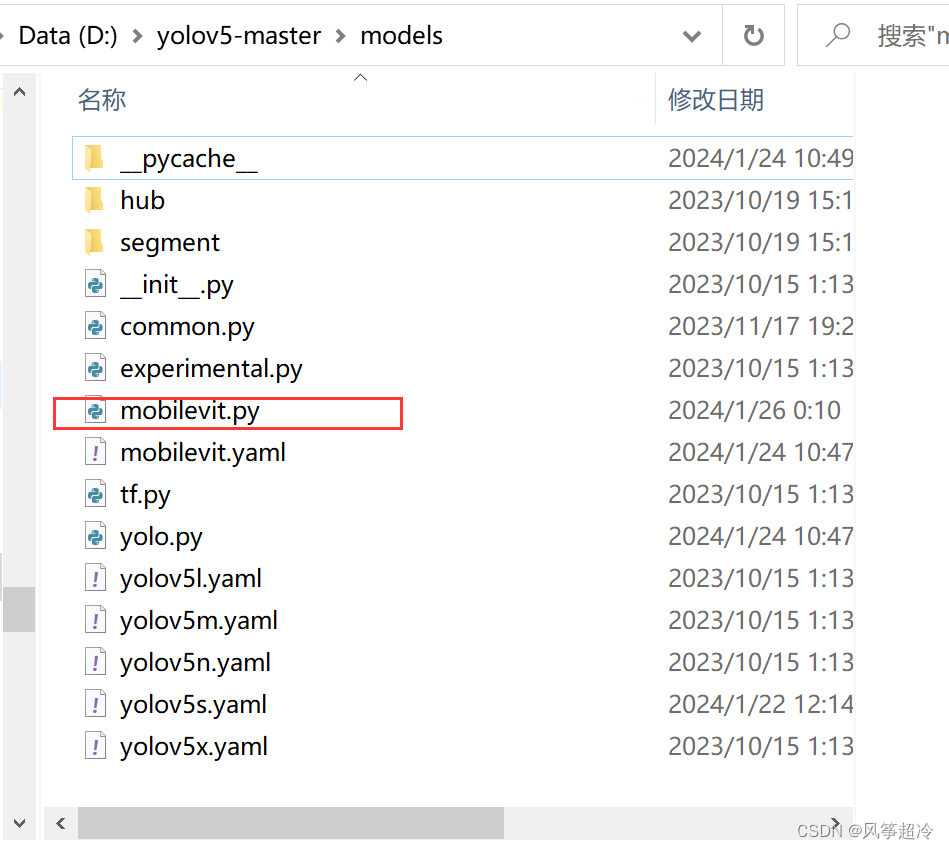
文件配置在D:\yolov5-master\models路径下
这篇关于【DeepLearning-8】MobileViT模块配置的文章就介绍到这儿,希望我们推荐的文章对编程师们有所帮助!